
Thermonix™
Reengineering thermal surfaces.
01EVAPORATOR COILS / MOISTURE MANAGEMENT
Thermonix™ Dehumidification
Dehumidification Coatings by Nanomatrix Materials
Thermonix™ DTx is an ultra-thin sheeting formulation nano-coating applied to HVAC evaporator coils. It changes condensate from isolated droplets into a thin, fast-draining film, promoting condensate removal and improving dehumidification without redesigning the coil.
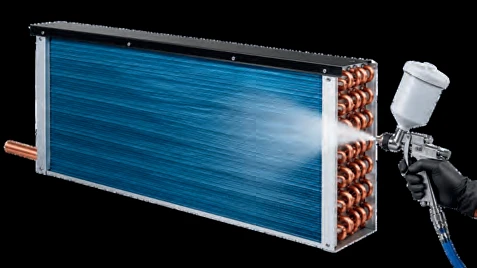
Continuous film formation
Condensate spreads as a thin, continuous sheet across the fin surface.
Faster drainage
Reduced water accumulation and bridging between fins help keep airflow passages clearer.
Greater moisture removal
The coating is designed to support higher latent capacity while retaining the existing coil design.
Independent lab comparison
| Parameter | Without coating | With Thermonix™ DTx | Change |
|---|---|---|---|
| Latent capacity (W) | 1,447.60 | 2,461.50 | +70% |
| Sensible capacity (W) | 12,367.40 | 11,802.20 | −4.60% |
| Total capacity (W) | 13,815.00 | 14,263.70 | +3.20% |
| Air pressure drop (Pa) | 29.88 | 28.48 | −4.70% |
| Water pressure drop (kPa) | 106.61 | 104.12 | −2.30% |
Same 3-row evaporator coil: 27.0°C DBT / 19.0°C WBT, 2.40 m³/h water flow. Brochure source: independent report #25-1660-TP01A-T01, NABL laboratory; 13-Jan-26 uncoated and 23-Feb-26 coated. The brochure headline reports +3.3% total cooling capacity; the table reports +3.20%.
02CONDENSER COILS / HEAT DISSIPATION
Thermonix™ Heat Transfer
Next-Gen Thermal Transfer Solution by Nanomatrix Materials
Thermonix™ HTx is a transparent, sub-10-micron graphene–nanoceramic coating applied directly to aluminium outdoor condenser coils. It targets the sensible-heat side of the system, improving heat transfer and heat dissipation while retaining the substrate, fin geometry, refrigerant circuit and airflow path, with no additional power draw.
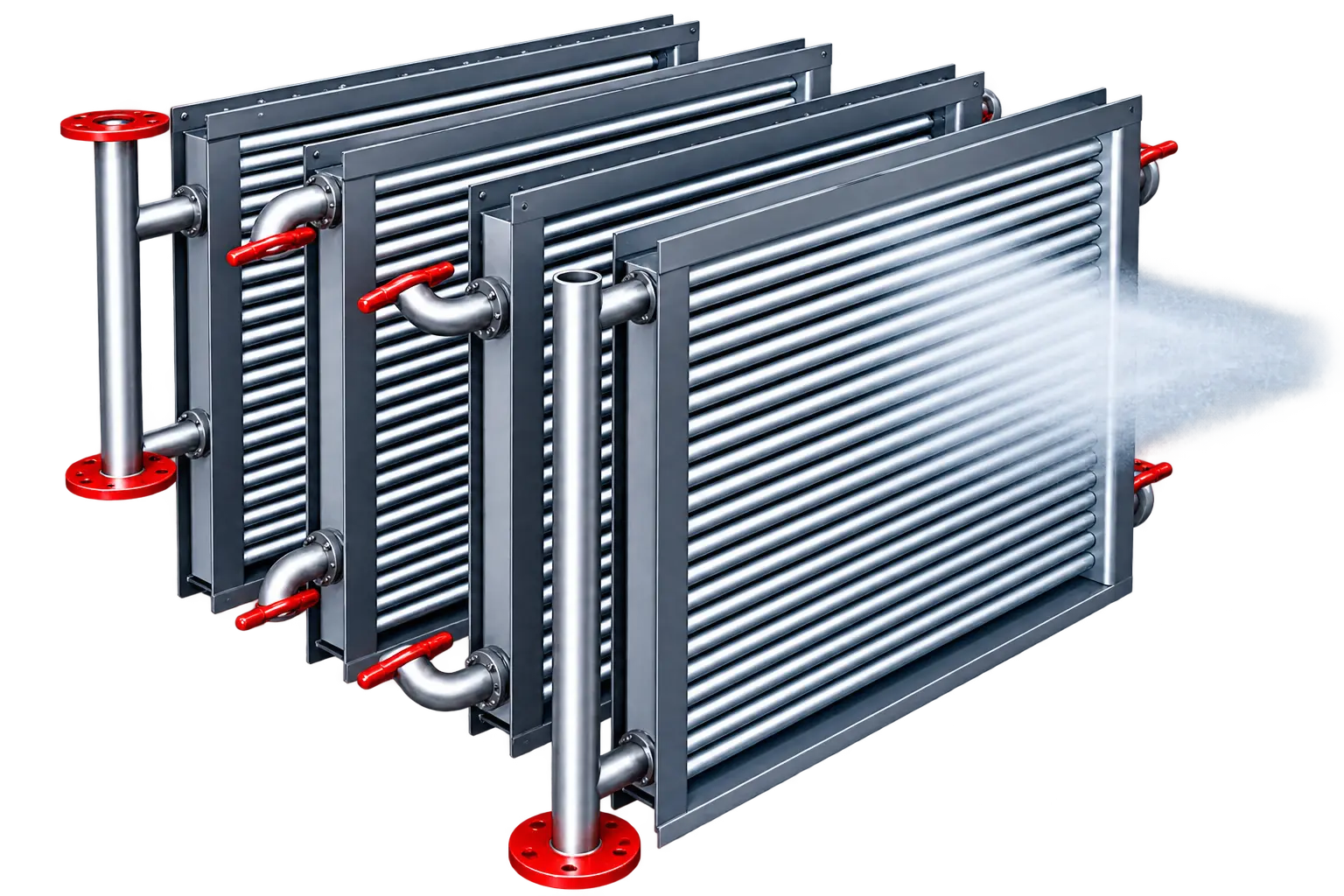
Graphene–nanoceramic layer
An ultra-thin nanocomposite bonds to the aluminium coil surface.
Through-thickness heat transfer
The coating supports thermal transport perpendicular to the surface, toward the air-facing layer.
System-level validation
The product guide reports field energy measurements, OEM unit comparisons and laboratory characterization as separate evidence.
OEM unit performance
| Operating condition | Sensible heat capacity · before | Sensible heat capacity · after | Sensible heat ratio · before | Sensible heat ratio · after | Final reported column · before (W) | Final reported column · after (W) |
|---|---|---|---|---|---|---|
| Fixed speed | 3,857 W | 4,057 W (+5.2%) | 84.2% | 86.4% | 4,579 W | 4,698 W (+2.6%) |
| Inverter · half load | 1,757 W | 1,992 W (+13.4%) | 87.3% | 90.5% | 2,013 W | 2,202 W (+9.4%) |
18K 3-Star Split AC, R-32; same unit before and after coating. The source repeats “Sensible Heat Ratio” above its final two columns, although their values are in watts. The figures are preserved here; the final-column heading requires confirmation.
Independent validation
| Parameter | Reported result / method |
|---|---|
| Energy savings | 20–25% measured in field testing |
| Air-side pressure drop | Measured reduction; no numeric percentage provided in this table |
| Z-direction thermal conductivity | 157.86 W/m·K · Laser Flash Analysis, ASTM E1461 · CMC Laboratories, USA |
| Thermal diffusivity | 19.25 mm²/s coated vs. 13.46 mm²/s non-coated · approximately 43% higher · Hot Disk TPS, MNIT Jaipur |
| Specific heat (Cp) | DSC cross-check by K.R. Mangalam University, New Delhi; reported as consistent with CMC Labs data |
Results compiled in the HTx brochure from field testing and laboratory characterization. These results relate to the stated test setups; they are not a guarantee for every installation.
MATERIALS / IN MOTION
Thermonix™
The product animation from our homepage.